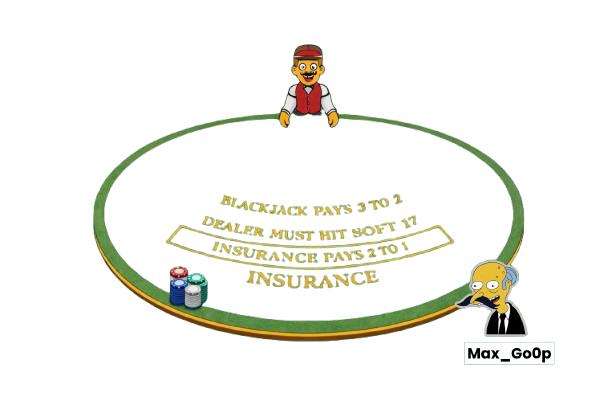
Monty doesn’t “guess” — he measures the shoe, tracks the edge, and only presses when the math is in his favor.
Below is the high-level logic (no code, no secret sauce), so you know what the terminal is doing.
1) Hi-Lo Card Counting
Every visible card is mapped to a simple value. Low cards help the dealer long-term; high cards help the player.
Monty uses the classic Hi-Lo mapping:
- 2–6 = +1
- 7–9 = 0
- 10–A = −1
As cards are dealt, Monty updates the count in real time — including dealer upcards and player cards on the table.
2) Running Count → True Count
The Running Count is the raw total of Hi-Lo values so far. But the same running count means
something different in a 4-deck shoe versus an 8-deck shoe.
That’s why Monty converts it into True Count by normalizing for how many decks remain in the shoe.
True Count is the number that signals “edge” in finite shoes.
3) Bet Sizing (Pressing the Edge)
When True Count is neutral or negative, Monty keeps bets conservative. When True Count rises,
Monty increases bet size in controlled steps.
This creates a simple rule: bet small when the deck is bad, bet bigger when the deck is rich in tens and aces.
The exact sizing is capped to avoid nuking bankroll on variance.
4) Decisions: Basic Strategy + Count Adjustments
On every hand, Monty starts with basic strategy — the mathematically optimal decision for the current hand and dealer upcard.
Then, when the count strongly favors certain outcomes, he applies small count-based adjustments
(for example: when to be more aggressive, when to avoid marginal doubles, and when certain insurance/surrender situations make sense).
The goal is simple: maximize EV while keeping play consistent.
5) Table Rotation
MontyLoop rotates tables on a timer. Each table represents a different environment:
4-deck, 6-deck, 8-deck, and Infinite.
That rotation isn’t just cosmetic — it changes the quality of the counting signal, the variance, and how quickly edges appear/disappear.
The dashboards above track per-table performance so you can see which setup Monty drains the hardest.
6) Why Infinite Deck Is Different
In an infinite deck model, every draw is effectively “fresh” — the probability distribution doesn’t shift as cards are dealt.
That means true count has no lasting edge, because the shoe never becomes rich or poor in high cards.
On Infinite, Monty relies far more on baseline decision quality and controlled bet sizing,
while finite tables reward strong count discipline when the shoe turns favorable.